

Palatalized implants
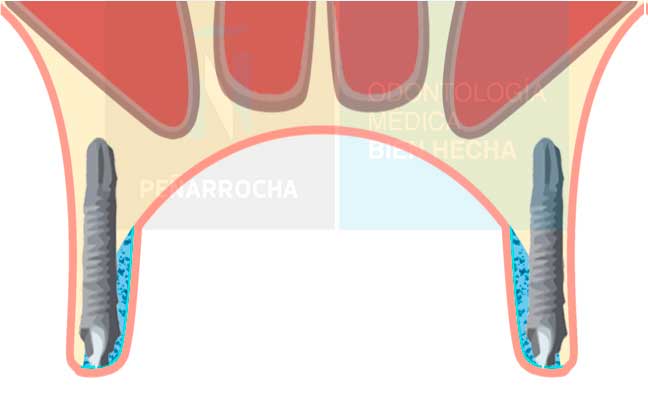
When teeth are lost, the maxillary bone that supported them gradually begins to resorb. Over the years, placing conventional dental implants becomes much more challenging.
Palatalized dental implants are the technique we use to address this problem without the need for bone grafting ni a cirugías más agresivas, aprovechando el hueso de mejor calidad que suele conservarse en la zona palatina (interna) del maxilar.
At the IDIM Institute of Implantology, as a dental implant clinic in Valencia, we have extensive experience in the treatment of maxillary atrophies and have contributed to the development and research of this technique through numerous scientific publications. We always assess each case individually to offer the best solution.
Fill in the contact form if you need to book an appointment at our dental implant clinic in Valencia:
Palatalized dental implants: an innovative solution for bone atrophy
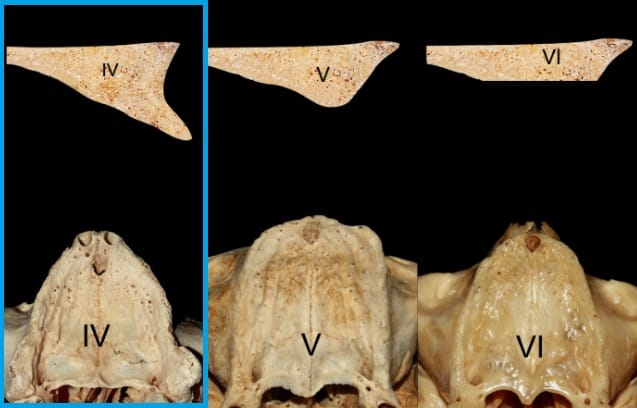
When one or more teeth are lost, the bone that once supported them no longer receives stimulation. The body gradually begins to resorb it, causing the jawbone to become narrower. This process progresses horizontally: first, the buccal cortical bone (the outer wall of the bone) becomes slightly atrophied, and over time, this bone loss becomes more pronounced, resulting in moderate grade IV atrophy.
To ensure that a dental implant is completely surrounded by bone and has a good long-term prognosis, approximately 8 mm of bone thickness is required (4 mm for the implant itself plus 2 mm of bone on each side). However, with moderate horizontal atrophy, only 2 or 3 mm of bone may be available. Placing a conventional implant under these conditions would leave some of its threads exposed, reducing stability and increasing the risk of infection and implant failure.
Palatalized implants are a technique described and developed by Drs. Peñarrocha. It involves placing the implant slightly towards the inner aspect of the upper jaw (the palate), where bone quality and quantity are usually greater. This approach preserves the buccal cortical bone, while the exposed implant threads on the palatal side are covered with bone graft particles.
When are palatalized implants indicated?
A palatalized implant is indicated when horizontal bone atrophy is present in the upper jaw and prevents an implant from being placed in the conventional position.
It is one of the leading treatment options, along with angulated implants, pterigoid implants and inmediate loading. In some cases, these techniques may be combined, particularly for full-arch rehabilitation or to treat more advanced bone atrophy.
However, not all patients are candidates for this technique. Each case requires an individualized assessment to evaluate the degree of bone atrophy, the available bone quality, oral hygiene and the patient’s general health, among other factors, before deciding whether to place a palatalized implant.
In general, this technique may be recommended in situations such as:
Horizontal bone atrophy in the upper jaw
Loss of the buccal cortical bone and insufficient bone thickness for a conventional implant.
Patients who wish to avoid bone grafting or bone augmentation procedures
More invasive and prolonged surgical procedures, with greater morbidity.
Bone resorption following the loss or extraction of several teeth
When significant time has passed since tooth extraction and the bone has already become narrower.
Full-arch rehabilitations
In patients with advanced maxillary atrophy who are seeking a fixed and stable solution while avoiding removable prostheses.
Advantages of palatalized implants
The main advantage of palatalized implants is that they make it possible to take advantage of the available bone in the palatal area, preserving the buccal cortical bone and promoting more stable bone regeneration.
These are the main benefits of palatalized implants:
Suitable for patients with limited maxillary bone
Even in cases of moderate or severe atrophy, when there is limited bone volume
Make efficient use of the existing bone
By using the best-quality bone available in the palatal area to anchor the implant
Improve implant stability
They provide aesthetic and functional benefits by preserving the buccal cortical bone and achieving an adequate band of attached mucosa
Avoid the need for block bone grafts
And help avoid more aggressive surgical procedures, reducing treatment times and making the process more comfortable
Facilitate fixed rehabilitations in complex cases
Even when combined with angulated implants, pterygoid implants or immediate loading techniques
Slow the progression of bone atrophy
By preserving the buccal cortical bone, helping maintain the existing bone structure and prevent further bone loss over the years
What does palatalized implant treatment involve?
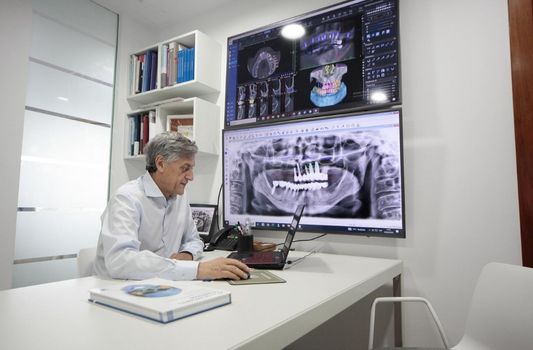
Each patient presents a different degree of bone atrophy, which is why treatment always begins with a personalized assessment. At IDIM, we use a fully digital workflow that allows us to plan the surgery precisely and design the rehabilitation before the procedure.
1. Comprehensive diagnostic assessment
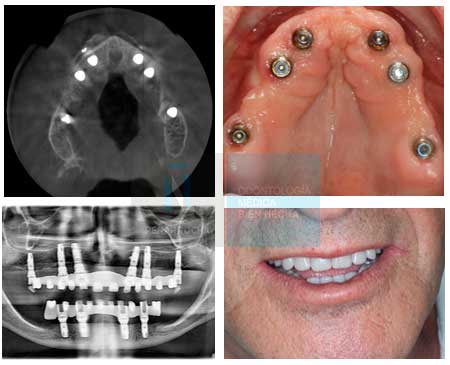
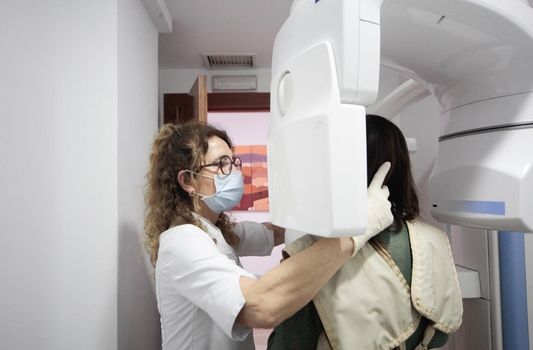
Treatment begins with a panoramic X-ray and a cone-beam computed tomography (CBCT) scan, together with clinical photographs and a comprehensive assessment of the case. This information allows us to accurately determine the amount and quality of available bone and the ideal position for each palatalized implant.
2. Placement of palatalized implants
The implants are placed slightly towards the inner aspect of the upper jaw (palatal side). This preserves the buccal cortical bone, helping to maintain attached mucosa on that side. Depending on the case, this technique may be combined with angulated implants, pterygoid implants or immediate loading techniques to complete the rehabilitation.
3. Palatal bone grafting
Once the implants have been placed, the threads that remain exposed on the palatal side are covered with bone graft particles, using platelet-rich plasma (PRP) obtained from the patient’s own blood. Approximately four months later, new, vital bone can be seen forming in this area, together with an increase in keratinized gingiva.
4. Provisional and definitive prosthesis
In many cases, patients can leave surgery with fixed provisional teeth on the same day, provided that the implants achieve sufficient primary stability and the planned type of rehabilitation allows it. Approximately 3 months later, once the implants have fully integrated and the bone has healed, the definitive prosthesis is placed.
5. Clinical follow-up
As with any surgical treatment, there are some minor risks: the risk of implant infection is approximately 3%, while the risk associated with bone grafting is around 5%. For this reason, it is essential to maintain good oral hygiene, attend regular check-ups, undergo professional maintenance every 6 months and reduce or avoid smoking.
Why choose IDIM for your palatalized implants in Valencia?
At IDIM, palatalized implant treatment is not simply a technique we have adopted as a trend: it is a technique that we have described and developed ourselves. Dr. Miguel Peñarrocha Diago, together with his son, Dr. David Peñarrocha, are internationally recognized experts in the treatment of severe maxillary atrophy.
Choosing IDIM for your palatalized implant treatment in Valencia means:
Experience in complex cases
We specialize in complex implantology cases and treatments. Our expertise demonstrates our advanced experience and successful outcomes.
Multidisciplinary medical team
We have a team of specialists trained in different areas of oral surgery and implantology in Valencia, working together to ensure the best possible results for each treatment.
Cutting-Edge Technology
Our advanced techniques and technology, including 3D scanners and digital treatment planning, allow us to perform precise diagnoses and personalized treatments.
Personalized Treatment
As every case is unique, at IDIM we design a tailored treatment plan, taking into account each patient’s specific needs to provide the most appropriate solutions.
Proven Results
We have numerous successful cases involving patients who have regained their teeth and now enjoy a renewed and functional smile thanks to palatalized implants.
Cost and Financing
We offer personalized treatment plans and quotes, together with financing options of up to 18 months, to make palatalized implant treatment more accessible.
Frequently Asked Questions About Palatalized Implants
f you still have questions about palatalized implant treatment, below we answer some of the most frequently asked questions by our patients during consultations.
Is the placement of a palatalized implant painful?
The procedure is performed under local anesthesia or conscious sedation, so the patient does not feel pain during the surgery. During recovery, it is normal to experience some swelling and mild discomfort, which can be well managed with the medication prescribed by the medical team. Most patients return to their normal routine within a few days.
How long does a palatalized implant take to heal?
New bone formation in the palatal area where the graft has been placed may begin to be visible after approximately 4 months. In general, complete implant integration and bone healing take around 3 months, at which point the definitive prosthesis is placed. However, the exact timeframe depends on the primary stability of the implants and each patient’s individual healing process.
Are palatalized implants suitable for all patients?
Not all patients are candidates for palatalized implants. Each case requires an individualized assessment to evaluate the degree of bone atrophy, the quality of the available bone, oral hygiene, habits such as smoking and the patient’s general health.
Can palatalized implants be placed with immediate loading?
Yes. In many cases, it is possible to place a fixed provisional prosthesis on the same day as the surgery. However, this depends on the primary stability achieved by the implants and the type of rehabilitation planned.
What is the success rate of palatalized implants?
The success rates of palatalized implants are very high and are supported by scientific studies. As with any surgical treatment, there are some minor risks: the risk of implant infection is approximately 3%, while the risk associated with bone grafting is around 5%. Maintaining good oral hygiene, attending regular check-ups and avoiding smoking can help preserve these results in the long term.
How much do palatalized implants cost in Valencia?
The cost of a palatalized implant is similar to that of a conventional implant with a simple palatal bone regeneration procedure. However, the final cost may vary depending on several factors, such as the number of implants required, the degree of bone atrophy and the type of definitive prosthesis. For this reason, a personalized treatment plan and quote is always provided following a comprehensive assessment.
Start your palatalized implant treatment in Valencia
At the IDIM Institute of Implantology, led by the Peñarrocha doctors, we don’t just care for your smile—we provide effective solutions, backed by our extensive experience and dedication.
We have more than 40 years of experience specialising in dental implantology, using advanced techniques and state-of-the-art technology to achieve the best possible results for our patients.
Fill out the following form and book an appointment for your palatal approach implant treatment in Valencia with no obligation.
+34 963 34 46 75